


Reducing Prompt Dependency


In ABA therapy, ‘prompts’ are additional stimuli (something that occurs which leads to a certain behaviour) provided to get a child to give a correct or expected response. In early stages of teaching a child new behaviours, responses or skills, prompts are almost always essential as it is new information which is not mastered by the child yet. With prompting, the goal is to nudge the child towards the correct direction, then gradually fade off prompts to encourage independence and mastery. There are various kinds of prompts that can be applied depending on the situation and the child’s current progress — these include visual prompts, physical prompts, verbal prompts, among others.
Below is a diagram that illustrates when in a sequence of learning where prompts should be administered. As seen, prompts can help affect the behaviour following the instruction.
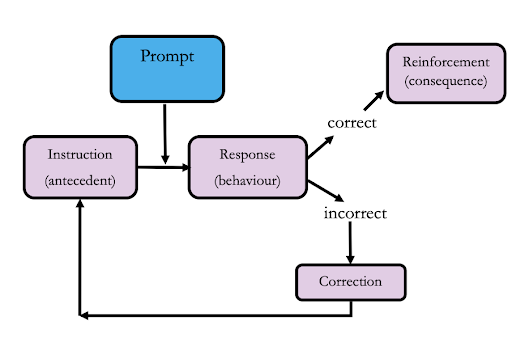
Prompts are important for learning, but there is a possibility that it may lead to prompt dependency. Prompt dependency is when the child is overly reliant on prompts to do something, waiting for the therapist to prompt the response, even if the behaviour or skill has already been taught for a while. Reducing prompt dependency is important to encourage independence and mastery in the child, so here are some things that can be done to achieve that.
Keep prompts minimal and efficient
Firstly, prompts should always be catered to the child’s own ability — meaning both their current capabilities as well as their ability to take in information, or which type of prompt is most effective for them. Where possible, prompts should be least intrusive so that it encourages more independence from the child, and is easier to fade off.
Prompts generally follow this hierarchy, with physical being the most intrusive and verbal being the least:
Physical: Physical assistance towards the correct response, such as guiding the child to do something by holding and moving their hand.
Model: The teacher performs the correct response for the child to observe and copy.
Visual: The teacher provides a visual cue containing hints of the expected response, such as a picture or written word illustrating the correct response.
Gestural: Gestures or actions indicating/hinting towards what the correct response should be. It may be to encourage a correct response, or to let the child know that something is the correct response. Examples include pointing or nodding.
Verbal: Any form of spoken cues that provide hints towards the correct response. Depending on what the correct response is, it may be a spoken instruction or a partial verbal prompt such as part of a word that the child is supposed to respond with. (e.g. “t…” if they are supposed to answer “truck”)
Physical → Modelling → Visual → Gestural → Verbal
Reduce unintentional prompting
As instructors and caregivers want to see the children succeed at the task or instruction, we may sometimes unintentionally prompt due to habit. However, it is important to understand that this encourages prompt dependency as the child might learn that prompts will be provided regardless of whether they have mastered the skill or not. Depending on the child, instructors should gauge whether they actually need to prompt the child or not. A slower response does not necessarily mean that the child does not know how to do something, and if the target of practice is accuracy of response rather than fluency (speed) of response, a prompt might not be needed just because the response is at a delay.
Being aware of when and how to fade prompts
“Fading” means to reduce the prompts systematically to allow the child to gain mastery, and is an essential step to reducing prompt dependency as the child should eventually be able to give the correct response with all prompts faded out. To prompt and fade to teach a skill or response, the instructor first delivers the instruction, then prompts accordingly to teach the correct response, rewarding the child after the correct response for reinforcement. Subsequently, the instruction should be repeated again with either a less intrusive/fewer prompts, or with no prompts at all, depending on the child’s level of progress. Fading prompts should be gradual, so it can be from a fully physical, intrusive prompt, to a partial physical or less intrusive prompt. It may also be increasing the amount of time that the instructor waits for a response before delivering the prompt. Doing so ensures that the child gradually relies less and less on heavy prompting, until they reach a level of mastery and can give the correct response without relying on prompts at all.
Even though prompts are important in the process of learning, the ultimate goal is for the child to be independent. As the child practises the skills and behaviours they are working on, instructors should also be matching their pace of progress to prompt (and fade) accordingly. Give the child sufficient opportunities to practise and work towards independence, and don’t forget to reinforce them when they succeed!
Written by: Kai Sin
References
Pexels. (2022). A teacher and a student [Photograph]. Pexels. https://www.pexels.com/photo/a-teacher-and-a-student-7750853/
Conte, J. (2021). Prompt Fading Helps Children with Autism Become Independent. The
Behavior Exchange.
Chicago ABA Therapy. (n.d.). 6 Types of Prompts Used in ABA Therapy.
Edwab, A. (2023). 5 Tips to Prevent Prompt Dependency. Sunny Days Sunshine Centre.
Rainy River District School Board. (n.d.). Prompting and Prompt Fading. ABA in the Classroom.


Comments